

How to Keep Pond Fish Alive in Winter (Pond Winterizing Tips)

by Tory Jon | Last Updated: September 03, 2026
Pond Academy is reader-supported. Buying through links on our site may earn us an affiliate commission. As an Amazon Associate I earn from qualifying purchases.
Seeing ice form over a fish pond can make any pond owner nervous. Hardy fish such as koi and common goldfish can spend winter outdoors when the pond suits the local climate, enough liquid water remains, and water quality and oxygen stay within a safe range.
Preparing before the first hard freeze makes winter care much easier. These steps cover fall cleanup, aeration, de-icing, feeding, pond depth, snow, and the quick checks that can prevent a small problem from becoming a fish loss.
How Do Fish Survive Winter in Ponds?
Fish are ectothermic, which means their body temperature and metabolism are strongly affected by the surrounding water. As the pond cools, koi and hardy goldfish become less active, eat less, and may spend long periods resting. This winter slowdown is often described as torpor, although it is not the same as mammal hibernation. The Merck Veterinary Manual explains how water temperature affects fish metabolism and care.
Hardy fish often gather in a calm, deeper part of the pond where temperatures are more consistent. They still need dissolved oxygen, and poor water quality can still harm them even when they barely move.
Surface ice does not mean the pond has frozen solid. Fish may survive beneath ice when enough liquid water remains and conditions below the surface stay suitable. A sealed surface and heavy snow increase winterkill risk by limiting gas exchange and light, while a shallow pond that freezes solid is fatal. Michigan State University Extension explains how snow, ice, decomposition, and low oxygen contribute to winterkill.
 Important
Fish that cannot tolerate your expected winter water temperatures must be moved before the pond becomes cold. Indoor housing needs enough room, a cycled filter, steady aeration, and gradual temperature acclimation. Tropical fish, plecos, guppies, and delicate goldfish varieties should not be assumed to have the same cold tolerance as koi or common goldfish.
Get Our Best Pond Tips Sent to Your Inbox for Free!
Join thousands of others and learn from our decades of pond building and maintenance experience! Your pond will thank you!
By subscribing you agree to receive emails from PondAcademy.com. We will always respect your privacy and you can unsubscribe at any time.
How to Keep Your Pond Fish Alive in Winter
No single device can make every pond winter-safe. The most dependable approach combines gradual fall cleanup, suitable pond depth, reliable gas exchange, careful feeding, and regular checks.
Clean the Pond Before Winter
Gradually remove excess leaves, dead plant growth, string algae, and other loose debris before the water becomes very cold. Decaying material uses oxygen and can contribute to poor water quality beneath the ice.
Use a hand net or pond rake for debris you can reach from shore. Properly secured pond netting can catch autumn leaves before they sink, but keep it taut and inspect it regularly so wildlife does not become trapped.
DeWitt Deluxe Pond Netting has 1/4-inch mesh intended to keep leaves and predators out while allowing air, light, and moisture through, according to the manufacturer's product information. It is useful for seasonal leaf control when it can be securely fitted above the pond.

Remove accessible sludge gradually instead of stirring deep waste throughout the pond. A pond vacuum can lift loose material without requiring a complete drain. The OASE PondoVac Classic is designed to remove sludge and debris from small to medium ponds and water features.
Do not power-wash the liner or try to sterilize the pond. Established biofilm on wet pond and filter surfaces helps process fish waste. Kansas State University advises against power washing these useful surface coatings. A less disruptive approach to cleaning a pond without draining it is usually safer for an established fish pond.
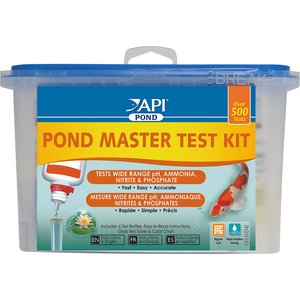
After completing the rest of your pond winterization, test the water. The API Pond Master Test Kit measures pH, ammonia, nitrite, and phosphate. It does not measure nitrate, dissolved oxygen, or temperature. Any detectable ammonia or nitrite calls for prompt investigation, especially if fish are behaving unusually. Correct the underlying cause and avoid abrupt pH changes.
When a partial water change is needed, closely match the replacement water temperature and treat municipal tap water for chlorine or chloramine before it reaches the fish. Use a conditioner labeled for the disinfectant present and dose it according to its label, as described in the API Tap Water Conditioner directions.
If fish show distress after untreated municipal water enters the pond, stop the incoming water, increase aeration, and promptly neutralize suspected chlorine or chloramine already added. Testing can confirm the cause, but it should not delay those first exposure-reduction steps.
Maintain an Opening for Gas Exchange
Fish need oxygen throughout winter. A small opening in surface ice allows gas exchange, although the opening alone does not guarantee safe dissolved oxygen levels.
A pond aerator can add oxygen and may keep a small opening clear during moderate freezes. Severe cold can close that opening, so inspect it regularly and add a pond-rated de-icer when needed.
A winter diffuser is commonly raised from the deepest area or placed on a shallower shelf. Strong circulation from the bottom can mix the more consistent deep water where fish rest with colder surface water. The best placement depends on pond depth, climate, fish load, and the equipment manufacturer's instructions.
The TetraPond APK100 is intended for outdoor ponds, and Tetra rates the kit for ponds up to 5,000 gallons. Pond depth, air-line length, fish load, and winter severity can reduce real-world performance, so monitor the opening and fish rather than relying only on the capacity figure.
Add a Pond De-Icer When Needed
A floating de-icer heats a small area at the surface. It is not intended to warm the entire pond. Its job is to maintain an opening when an aerator alone cannot keep up with the cold.
The TetraPond Floating Pond De-Icer is a thermostatically controlled 300-watt model intended for outdoor ponds. The manufacturer describes it as a localized de-icer, so continue checking the opening during extended cold weather.
Use only equipment specifically rated for outdoor pond use, the intended pond size, and expected winter conditions. Powered pond equipment should use outdoor-rated, GFCI-protected service with intact cords and weather-protected connections. The Electrical Safety Foundation International explains how ground-fault circuit interrupters reduce shock risk in wet locations. Have a qualified electrician correct any questionable outlet or wiring.
Important
Never walk onto ornamental pond ice or strike it to make a hole. Work from shore with a long-handled tool, and keep children and pets away. The shock from hitting the ice can stress fish and damage the liner.
Different outdoor-rated devices are compared in our guide to pond heaters and de-icers. Owners facing unusually severe conditions can also review safe options for heating a pond in winter, but an indoor aquarium heater is not a substitute for outdoor pond equipment.
Adjust the Feeding Schedule
As the water cools, fish digest food more slowly. Feeding more than they can use adds waste while biological activity in the pond and filter is also slowing.
Measure pond temperature instead of relying on air temperature. Use a pond thermometer that can measure the water where the fish spend their time, and follow the temperature directions for the exact food you use.
Tip
Feed only fish that are actively interested in food. Offer a small amount, remove leftovers, and stop or disable automatic feeding as the fish become inactive.
Use this table as a cautious starting point. Food formulas have different temperature instructions, so the product label takes priority.
| Pond water temperature | Feeding guidance |
|---|---|
| Above 60°F (16°C) | Follow the food directions and give only what the fish finish promptly. |
| 50 to 60°F (10 to 16°C) | Reduce the amount or frequency according to the food label and fish activity. |
| 40 to 50°F (4 to 10°C) | Feed sparingly only when fish are active and the food is labeled for this range. Remove leftovers. |
| Below 40°F (4°C) | Stop feeding koi and hardy goldfish. |
Kaytee's current directions for Koi's Choice call for one or two daily feedings from 50°F to 60°F, every-other-day feeding below 50°F, and no feeding below 40°F. That makes this exact food an option when its directions match the measured water temperature, but it should not be fed merely because winter fish appear near the surface.
Our advice on winter fish feeding covers temperature and fish activity in more detail. Turn off any automatic fish feeder once the fish stop eating consistently.
Make Sure the Pond Is Deep Enough
There is no single minimum depth that works for every pond. Climate, fish species, pond volume, exposure, and local frost conditions all affect how quickly water cools and how much liquid water remains during a freeze.
The University of Minnesota Extension describes 18 to 24 inches as a common water-garden depth and recommends at least 3 feet for koi ponds. Treat those figures as planning benchmarks, not guarantees. Koi in a severe climate may need more depth and volume, while a mild-climate water garden with a few hardy goldfish has different needs.
Before building or deepening a pond, check local frost conditions, excavation and safety codes, and experienced regional pond guidance. A properly designed koi pond also needs adequate filtration, aeration, and room for adult fish. Depth alone cannot correct overstocking or poor water quality.
If an existing pond is shallow enough that it may freeze solid, move the fish to a properly prepared indoor holding system before winter rather than relying on a de-icer to protect the entire pond.
Remove Heavy Snow From Shore
Snow blocks light from reaching the water. Removing some snow may improve light penetration and allow limited photosynthesis beneath the ice, but it does not assure safe dissolved oxygen.
Even oxygenating pond plants cannot be the pond's only winter oxygen safeguard. Many plants are dormant, and decaying vegetation can use oxygen. Prioritize monitored aeration, gas exchange, water quality, and fish behavior.
Michigan State University Extension recommends removing snow from part of an ice-covered pond to help light reach aquatic plants. When this can be done safely, use a long-handled soft broom from shore. Do not step onto the ice or strike it. Finish other winter pond-plant care before the pond freezes.
Check the Pond Daily During Freezing Weather
A winter pond check only takes a few minutes. Watch for:
- A closed aeration opening or de-icer that has stopped working
- Fish gasping, rolling, or gathering tightly near moving water
- A falling water level
- Ice redirecting water from a waterfall or return
- Frozen, shifted, or leaking plumbing
- Damaged electrical cords or wet connections
Increase aeration if fish are gasping, then test the water and inspect the equipment. Disconnect electrical power before touching damaged or waterlogged equipment.
Can Fish Survive Being Frozen?
No. A fish cannot survive if its body freezes, and fish cannot live in a pond that freezes solid around them.
A pond with surface ice has not necessarily frozen solid. Hardy fish may survive beneath the ice when liquid water, adequate oxygen, and acceptable water quality remain. Keeping a monitored opening lowers the risk of trapped gases and declining oxygen, but it does not replace proper pond depth and routine checks.
Can Koi Survive Winter in an Outdoor Pond?
Healthy koi can overwinter outdoors in a pond designed for the local climate. Depth, oxygen, water quality, stocking level, and fish condition all affect the outcome.
Goldfish varieties differ in cold tolerance. Common goldfish, comets, and shubunkins are generally better suited to outdoor winter conditions than delicate fancy varieties.
Should I Cover My Pond in Winter?
Most backyard ponds do not require a cover. A properly designed, greenhouse-style enclosure may reduce heat loss and keep debris out, but it must be ventilated and built for local snow and wind loads.
Do not lay a swimming-pool cover directly on the pond. A cover must not seal the water, rest where it can trap animals or people, or create a collapse and access hazard.
Should I Run My Pond Pump in Winter?
That depends on the climate, pond design, plumbing, and pump instructions. A pump can maintain circulation, but exposed returns and waterfalls may freeze. Ice dams can redirect water outside the pond and lower the water level.
Pumping from the deepest part of the pond can also mix the more consistent water where fish rest with colder surface water. Some owners shut down waterfalls and use a separate winter aerator and de-icer instead. University of Illinois Extension discusses adjusting pumps, feeding, aeration, and de-icing for winter conditions.
If you keep the pond pump running, inspect the water level, flow, returns, and exposed plumbing during freezing weather. A biological pond filter works more slowly in cold water, so do not expect warm-weather performance.
Follow the pump manufacturer's storage directions if you shut it down. Some pumps must be stored submerged, while others have different requirements. The same outdoor electrical safeguards apply whether the equipment runs all winter or is used only during freezes.
Do Pond Fish Need Feeding in Winter?
Feeding depends on measured water temperature, fish activity, and the instructions for the food being used. Use the table above as a starting point rather than a fixed schedule.
When spring arrives, wait for temperatures and fish activity to rise consistently. Restart with small amounts and follow the food label. Our guidance on starting to feed after winter explains how to make that transition gradually.
How Do I Keep Pond Fish Warm in Winter?
Hardy pond fish normally do not need the entire pond heated. They need enough liquid water, suitable depth, acceptable water quality, and reliable gas exchange.
A pond-rated de-icer maintains a localized opening without trying to warm the full pond. Active heating may be appropriate for unusual fish, very small systems, or climates where the pond cannot retain enough liquid water, but it requires equipment explicitly rated for the pond size, outdoor use, and expected winter conditions.
Sources
- Michigan State University Extension: Avoid Winterkill in Your Pond
- University of Minnesota Extension: Creating and Caring for a Water Garden
- University of Illinois Extension: Winter Care for Water Gardens
- Merck Veterinary Manual: Management of Aquarium Fish
- Electrical Safety Foundation International: Ground Fault Circuit Interrupters (GFCIs)
- API Fishcare: Pond Master Test Kit
- API Fishcare: Tap Water Conditioner
- Tetra: TetraPond APK100 Air Pump Kit
- Tetra: TetraPond De-Icer
- DeWitt Company: DeWitt Deluxe Pond Netting
- OASE: PondoVac Classic
- Kaytee: Koi's Choice Fish Food
- Kansas State University Research and Extension: Water Gardening: Maintenance


